
Zack Riordan Unfiltered.
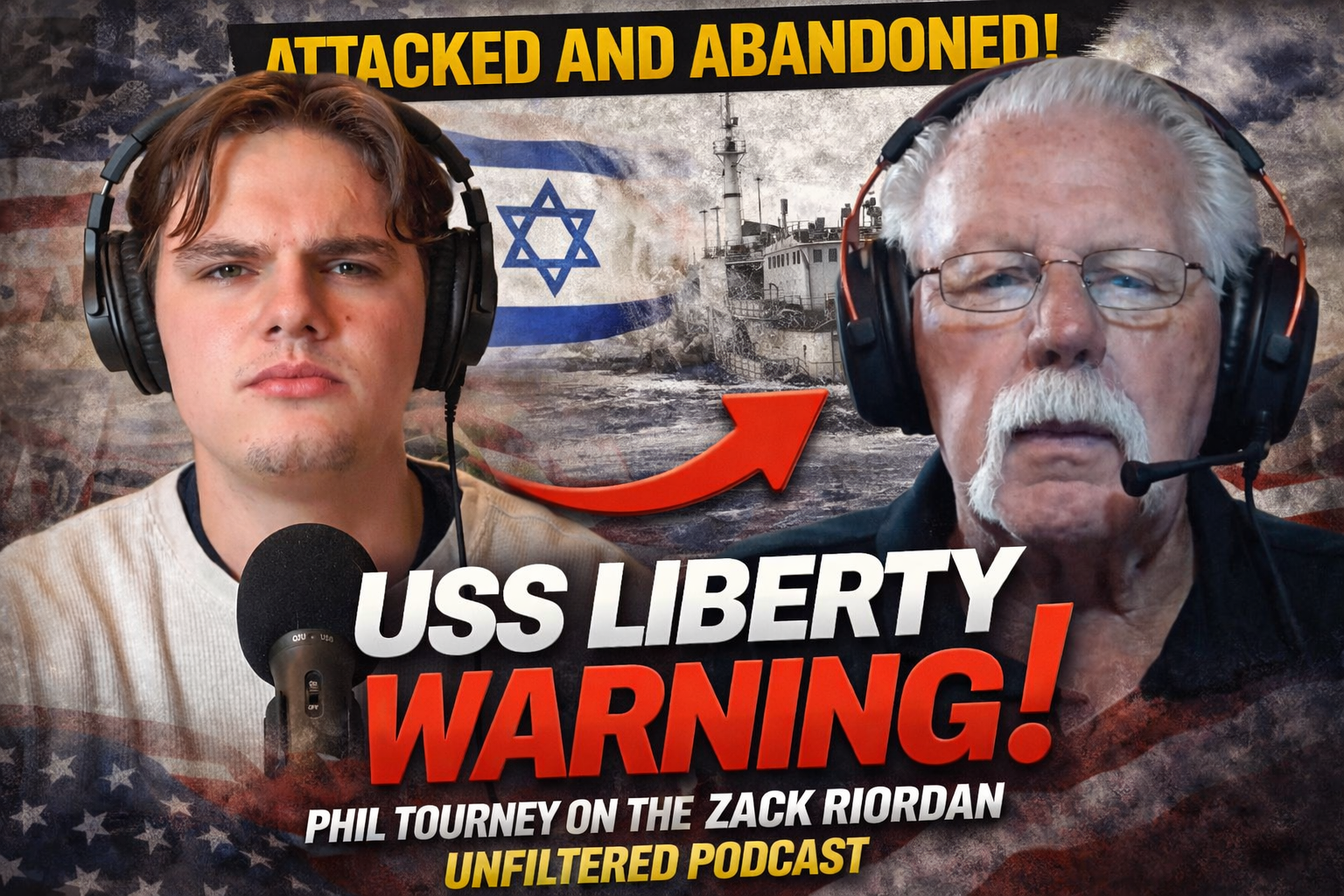
For nearly 60 years, USS Liberty survivor Phil Tourney has been trying to tell the American people what happened on June 8, 1967. In this powerful interview with Zack Riordan, he shares a firsthand account of an attack that left 34 Americans dead — and a story that many believe was never fully told.
What you’re about to hear isn’t history from a textbook — it’s the voice of someone who lived through it.
🎙️ The USS Liberty Story They Never Buried | Phil Tourney on Survival, Secrecy, and Speaking Up
Some episodes entertain. This one confronts.
In Episode #7 from the Zack Riordan Unfiltered Podcast, Phil Tourney doesn’t just revisit a historical event. He relives the day the USS Liberty was attacked, the men who never made it home, and the decades-long fight to keep that story from being erased. Whether you agree with every conclusion or not, one thing is clear: this is not a casual conversation. It is a survivor’s testimony, delivered with urgency, grief, and zero interest in playing nice.
Episode Overview
In Episode #7, host Zach sits down with USS Liberty survivor Phil Tourney for a raw, emotional, and deeply charged conversation about the June 8, 1967 attack on the American naval vessel. Tourney walks through his early life, his path into the Navy, the moment the attack began, the chaos aboard the ship, and the lifelong burden carried by the men who survived it.
The conversation also moves beyond the attack itself. Tourney speaks about what he sees as a government cover-up, the emotional toll of being silenced, the pain of losing shipmates, and the mission that still drives him: making sure the USS Liberty and its crew are not forgotten.
🎯 Key Takeaways
Phil Tourney frames the USS Liberty attack not just as a military tragedy, but as a truth battle that never ended.
The episode focuses heavily on firsthand detail: the air assault, napalm, torpedoes, destroyed communications, and the helplessness of being under fire without real support.
Tourney argues that the official explanation never matched what survivors experienced that day.
The interview is as much about memory and moral injury as it is about military history.
At its core, this episode asks a hard question: what happens when survivors believe their own government would rather move on than tell the truth?
🧠 Summary
This episode opens with a blunt setup: the USS Liberty was attacked in the Mediterranean on June 8, 1967, leaving 34 Americans dead and 171 wounded. From there, Phil Tourney takes over and gives the story human weight. He talks about growing up in a military family, joining the Navy at 17, serving in Vietnam, and eventually being transferred to the Liberty without fully understanding what kind of mission the ship was on.
Once the attack begins, the conversation turns intense fast. Tourney describes the opening assault as sudden and overwhelming. He recalls antennas being hit almost immediately, defensive capability being crippled, distress signals jammed, and fires breaking out from napalm. He tells the story not like a detached witness, but like someone still carrying the images in real time. The death of shipmates, the inability to fight back, and the sheer confusion of the moment remain central to how he remembers that day.
But the real engine of the episode is what came after. Tourney says the pain did not end when the shooting stopped. In his telling, the deeper wound was the silence that followed: survivors sidelined, official conclusions wrapped up too neatly, and a public that either never heard the story or heard a version he believes was incomplete. That sense of betrayal fuels nearly everything he says in the interview.
By the end, this becomes more than a war story. It becomes a statement about duty to the dead. Tourney’s message is simple and relentless: he believes the men lost on the USS Liberty deserve to be remembered honestly, and he intends to keep speaking until he no longer can.
🔎 Practical Tips
When covering historical events, separate documented facts, official findings, and survivor testimony so readers understand what is being claimed by whom.
If an event still carries emotional and political weight, lead with clarity over drama. The subject is already heavy enough.
Survivor interviews work best when you preserve the human stakes, not just the headline.
For controversial episodes, frame the strongest moments around what the guest experienced directly.
Use timestamps aggressively. On episodes like this, they help audiences navigate dense and emotional material without getting lost.
📚 Research Spotlight
Research on combat trauma and moral injury has shown that the effects of catastrophic military events can last for decades, especially when survivors feel the public record never fully accounted for what they lived through. That helps explain why testimony like Phil Tourney’s still carries so much emotional force nearly sixty years later.
❓FAQ
Who is Phil Tourney?
Phil Tourney is a survivor of the USS Liberty attack and a longtime public advocate for preserving the memory of the crew and challenging the official narrative surrounding the incident.
What is the main focus of Episode 7?
The episode centers on Tourney’s firsthand account of the attack, the loss of American servicemen, and his belief that the aftermath involved suppression rather than transparency.
Is this episode historical analysis or personal testimony?
It is primarily personal testimony. The power of the episode comes from hearing how a survivor remembers the attack and the decades that followed.
Why does this episode stand out?
Because it is not polished or detached. It is emotional, confrontational, and deeply personal. That gives the conversation weight most history retellings do not have.
⏱️ Chapters & Timestamps
00:01 - Introduction to the USS Liberty story
00:32 - What happened on June 8, 1967
01:18 - Phil Tourney joins the show
01:40 - Growing up, family, and joining the Navy
04:14 - Transfer to the USS Liberty
09:17 - What the crew thought the ship was doing
16:53 - The attack begins
18:19 - Distress signal sent out
19:16 - Claims that rescue aircraft were recalled
20:45 - Napalm and fire on deck
25:22 - Torpedo boats and the deadliest phase of the attack
27:39 - Life rafts destroyed
28:35 - Flags, markings, and ship identification
42:26 - The investigation and cover-up claims
46:17 - How many survivors are still left
47:58 - Captain Tully and the attempted rescue
50:03 - Why Tourney says the ship was easy to identify
53:14 - Faith, survival, and meaning after tragedy
55:56 - Where to support Phil Tourney and Liberty veterans
🧭 Final Thought
Some stories fade because they are settled. Others stay alive because the people who lived them refuse to let them be buried.
